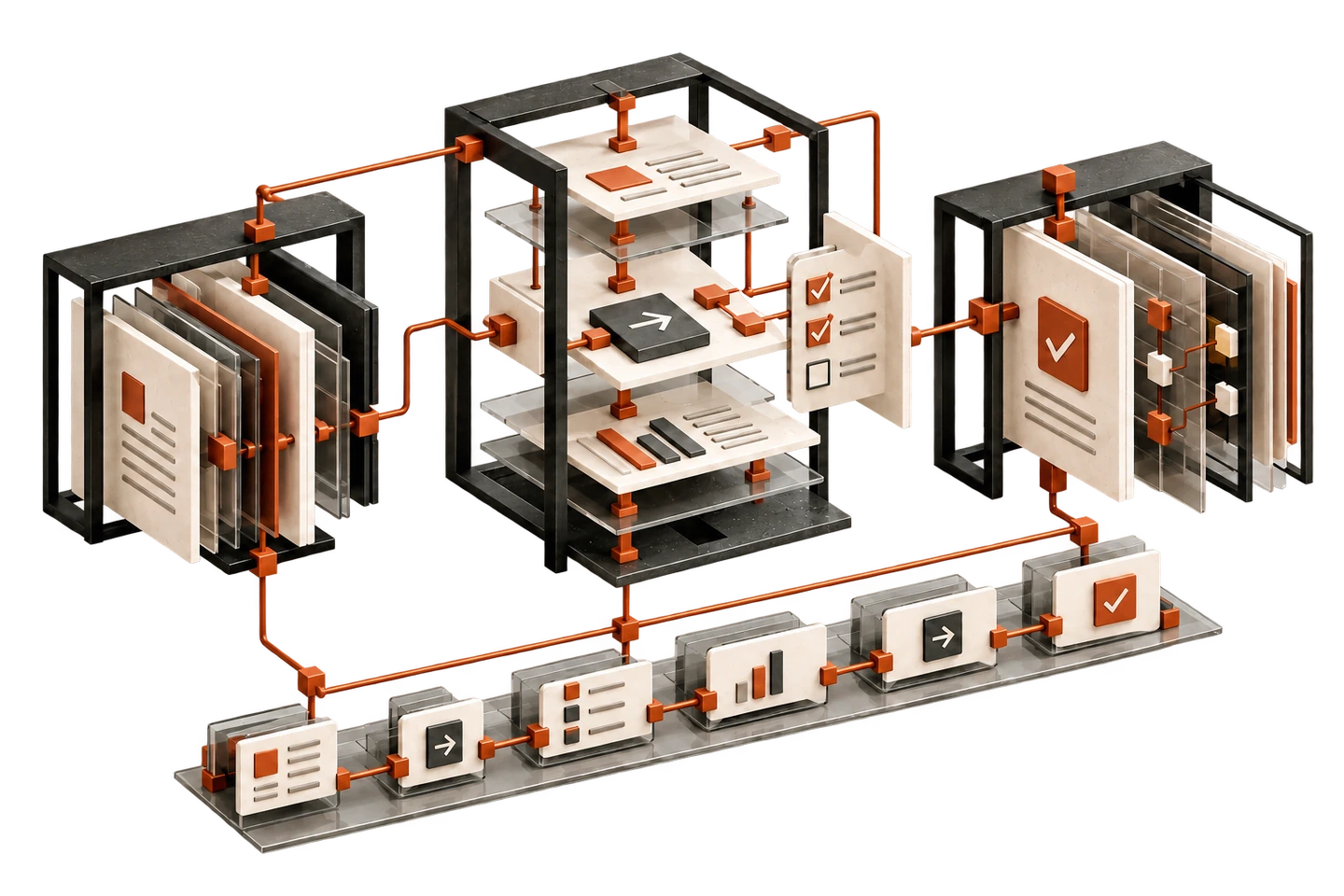
Agents as distributed systems, not chatbots
Long-running enterprise agents fail when leaders treat them like chatbots instead of distributed systems that need orchestration, identity, and continuous control refresh.
One brief, every Monday. Sourced, edited, free.
Long-running enterprise agents fail when leaders treat them like chatbots instead of distributed systems that need orchestration, identity, and continuous control refresh.
When an agent screens a candidate, approves leave, routes a case, or flags a performance concern, the HR system of record keeps the result. It usually has nowhere to put the actor.
After an agent uses a tool, can an independent reader join the approval to the execution?
When one agent can assign the course, finish the module, and write the record, L&D has a control-path problem.
Agents execute privileged work from trusted operational signals using permissions they already hold. Identity answers who may act. It does not prove the action can be stopped in time.
HR and learning suites are being rebuilt as agent platforms. That product move proves vendor positioning. It does not prove that workflow-integrated learning now works.
AI changes what human work contains before it removes the role. The hard problem is job redesign and accountability, not headcount.
AI can make production cheap enough that assurance becomes the scarce capacity.
AI can make a learner perform better while quietly performing part of the cognitive work that performance is supposed to demonstrate. The control problem is calibrating assistance—and testing what remains when it is withdrawn.
Permissions can determine whether an agent may act. They cannot determine whether it correctly understands the entity, metric, relationship, and context the action depends on.
Enterprise AI agents can expose inferred user intent to external services while still evaluating possible actions—before either the user or the agent commits to the branch anyone later audits.
As AI systems infer skills and recommend roles, projects, mentors, and learning, they begin allocating access to opportunity—not merely advising employees.
HRIS–LMS roster drift becomes an authorization and evidence problem when AI agents act on stale workforce identity, role, and eligibility data.
AI can make training production faster, but production-grade content needs traceable sources, review history, and outcome validation before it can be trusted.
When an assistant can help produce the completion signal, a clean LMS record may no longer prove a human learned.
An early-signal hypothesis: curriculum production, delivery, records, and platform infrastructure may be converging into one operating pipeline.
Why workplace learning needs performance evidence, not participation records.
Enterprise agents need a workforce record, not just an identity.
Why generative AI in corporate learning accelerates the production of assets faster than enterprises can validate that any learning actually occurred.
Why enterprises can create AI agents faster than they can change, constrain, pause, or retire their authority.
Why L&D delivery cadence is becoming the binding limit on enterprise AI value capture.
Why two enterprises with identical AI tooling are about to report opposite returns.
Superseded by Brief No. 010, The Proxy Learner Problem.
Why the first enforcement action is closer than vendors are pricing in.
Sourced. Edited. Delivered every Monday at 07:00 ET. Free.